The Third Plate by Dan Barber - Review
"The Third Plate" makes the argument that everything wrong with how we eat traces back to the dirt — and the people trying to fix it are magnificent, quixotic lunatics.
June 16, 2026
I distinctly remember being in college and starting Chef’s Table on Netflix on a whim. At that point in my life, big food was good food. My guiding lights were Guy Fieri and Adam Richmond, and wherever they ate was church. Michelin wasn’t even a consideration. To me that was small food for big bucks. So turning on a docuseries that spends an hour each episode deep diving into what makes a fine dining chef tick was incongruous with where I was at in my life at the time.
Despite that, I was fascinated by the pilot episode which featured Massimo Bottura’s attempts to irreverently upend the Italian cuisine status quo. It never even occurred to me that food could be a vehicle for storytelling. Oops! I Dropped the Lemon Tart and Tortellini Walking on Broth were critical to that moment of awakening.
And just as soon as I was hooked on the possibility of all that food could be, I quickly became disillusioned once more when the next episode started: a restaurant on a farm in New York that was on a mission to feed the world through sustainable agriculture. And I watched as this restaurant brought tomatoes on the vine to the tables of customers and said “Enjoy! That’ll be $200”—the horror! This was not what I had signed up for! Organic? Farm to table? All buzzy words to add an air of pretension to a squash in the hopes of charging twice as much for it at the grocery store. Blech!
I can’t recall if I watched the whole way through that episode but I do know I didn’t watch another episode ever again. That is until I rediscovered Dan Barber and his restaurant, Blue Hill at Stone Barns, by coincidence in having this book recommended to me. This time around it was like a switch turned on for me.
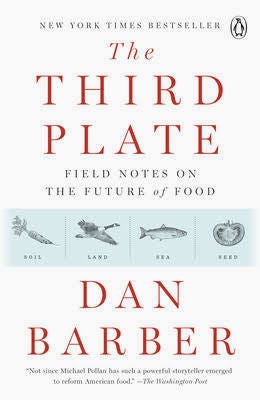
In The Third Plate Dan Barber takes you on an odyssey to discover what true sustainable agriculture can mean for the world—told through the lens of a man discovering these same truths on his own farm in support of his own restaurant.
The Chef’s Table episode serves as a solid source of supplemental material to the book and gives a bit more color to the origins of the farm itself. But one thing in particular that Barber reflects on in that episode that struck me is the realization that there’s a symbiosis to the inclusion of various animals on the farm. Cows provide fresh milk, but the chickens break up the manure from the cows and strengthen the quality of the grass, which improves the quality of the milk. Goats eat at the bramble on the edges of the farm to keep the encroaching forests at bay, which gives pigs the benefit of roaming for food in the forests. And all these knock-on effects that create an ecosystem on the farm only serve to improve the quality of the end product.
And ultimately that’s the discovery of Barber’s Third Plate—a story of a man who becomes obsessed with experimentations on the farm that yield a stronger product. So he started a research facility on the farm to help shepherd along those experimentations, for the benefit of his farm but also the ecological farming system in the Hudson Valley area.
In one particular anecdote of the book, one of his farmers, Jack, presents to him a carrot they’ve been able to grow on the farm that is then measured for its natural sweetness using a refractometer. The result is a number so high it blows any other carrot out of the water.
And these obsessions with the marginal improvements are what make the book so fascinating. Most people consider a carrot to be a carrot. Underneath that presupposition is an entire world of layers in which, no, a carrot has range. And if you want access to the best carrots imaginable you’ll have to dig deeper than the organic section of your local grocery store. The true masters of the carrot craft are idyllic lunatics who spend their time finding ways to make the dirt around the carrot marginally better.
Through this obsession with crafting the best carrots and squash, and butter and milk, Dan Barber quickly finds himself on an odyssey around the world (well actually, mostly Spain) to encounter some like-minded and truly insane madmen with a singular vision to upend the status quo.
One such example is a man in Extremadura in Southwestern Spain whose dedication in life is towards ethical production of foie gras. Foie gras, or fatty liver, is a very controversial food product that has even been banned in some countries. The controversy stems from the practices employed to fatten up the ducks or geese; gavage—sticking a tube down its gullet and forcibly feeding it.
Eduardo Sousa—the Extremaduran, has found another way. In much the same way the prized Iberico pigs subsist on a free range diet of acorns and plenty of good, natural exercise, Eduardo’s geese are simply naturally feed and allowed to fatten up on their own terms. He understands their behaviors and predilections and leans into that. And as a result he achieves the same fatty liver effect without the nasty work of shoving a tube down an animal’s throat.
It’s the stories like Eduardo’s where The Third Plate comes alive. The practical execution of a different way to produce the food we consume in a more ethical and ecologically sound manner is a testament to what we could achieve if more people cared enough.
But that’s the unfortunate rub of the story. Dan Barber’s mission is quixotic. People do not care because they’ve been led to believe they shouldn’t need to care. The convenience of ingredients available year round in American supermarkets is wildly too convenient to want to change course and invest in the infrastructure needed to fulfill this vision of how agriculture should work.
But windows do shift. I told the story about my own rediscovery of Dan Barber and his philosophy to highlight this shift. I wasn’t at the right point in my life to hear what his farm had to say. It’s not an overnight revolution. But bit by bit research centers like Dan Barber’s Stone Barns Center could make valuable inroads on the way farmers choose to approach their operations. The hardest part, it occurs to me though, is persistent adherence to what works. Cutting corners is backsliding into unsustainable habits.
I highly recommend this book to anyone who is curious about the history of why we do the things we do in food production and how we can test the bounds on new ways to do things better. The framing of the importance of this material through the lens of a man striving to find marginal improvements on his own farm strengthens the fact that all of these ideas are achievable. And it doesn’t have to be at the expense of the end consumer’s experience either. After all, who doesn’t want to try a sweeter carrot?